- Dex1-1 Plus grippers A two-finger gripper on each arm closes on an object and holds it reliably, cycle after cycle.
- Built for locomotion work Light, robust arm ends suit walking, balance, whole-body control and navigation research.
- 28 degrees of freedom Each gripper adds one degree of freedom to the R1's 26 body joints.
- 100 TOPS at the lowest Pro cost The Pro G pairs end effectors with the 100 TOPS NVIDIA Jetson Orin at the lowest cost of the Pro range.
- Hands later, if needed Dexterous hands can be fitted after purchase when the research moves toward manipulation.
- Open for development Students and researchers program it through unitree_sdk2 in C++ or Python, with ROS 2 compatibility and R1 simulation models.

Beschreibung
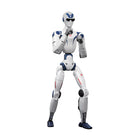
The Unitree R1 EDU Pro G (U9) is the R1 EDU with a Dex1-1 Plus two-finger gripper on each arm: Unitree's 1.23 m, 26-joint walking humanoid, a 100 TOPS NVIDIA Jetson Orin for development and 28 degrees of freedom with its grippers. It is the lowest-cost R1 EDU that combines working end effectors with the Pro editions' 100 TOPS of compute.
Dexterous hands are the most expensive and most often damaged part of a humanoid. If the work is locomotion, whole-body control, navigation, SLAM or human-robot interaction, multi-fingered hands add cost, mass and failure points at the end of the arm without adding much to the research. Grippers close on an object and hold it reliably, survive years of student use and keep the arm ends light.
The U10 Pro H moves up to tendon-driven five-finger hands and the U7 Pro E to linkage-driven Linker Hand O6 hands, while the Dex3-1 editions U3 and U4 sit at the top for force control and touch. If 100 TOPS is not needed, the U1 Standard has no hands and a 40 TOPS module. Hands can be fitted later when the work moves toward manipulation, which costs less than buying dexterity up front that then sits idle.
The R1 EDU body stands about 1.23 m tall and weighs about 29 kg with its battery, with six joints in each leg, five in each arm, two in the waist and two in the head. A binocular camera sits in the head, a quick-release smart battery gives about an hour of running, and the charger and remote controller come with the robot. Secondary development runs through Unitree's unitree_sdk2 in C++ and Python on DDS, compatible with ROS 2, with simulation models of the R1. Plan a support gantry while developing locomotion, and at least one spare battery.
Key Capabilities
- Dex1-1 Plus grippers: A two-finger gripper on each arm closes on an object and holds it reliably, cycle after cycle.
- Built for locomotion work: Light, robust arm ends suit walking, balance, whole-body control and navigation research.
- 28 degrees of freedom: Each gripper adds one degree of freedom to the R1's 26 body joints.
- 100 TOPS at the lowest Pro cost: The Pro G pairs end effectors with the 100 TOPS NVIDIA Jetson Orin at the lowest cost of the Pro range.
- Hands later, if needed: Dexterous hands can be fitted after purchase when the research moves toward manipulation.
- Open for development: Students and researchers program it through unitree_sdk2 in C++ or Python, with ROS 2 compatibility and R1 simulation models.
The price shown is for one R1 EDU Pro G (U9). Spare batteries, a support gantry, extra end effectors and class or project orders are quoted separately.
Buying through Robotix Market
This unit is sourced new through established distribution channels and ships worldwide with the manufacturer warranty. Technical support is coordinated with the manufacturer's own service network. Deployment scope and configuration are agreed before dispatch, and on-site installation is not included in the product price.
Funktionen
Technische Daten
| Brand | Unitree Robotics |
|---|---|
| Model | R1 EDU Pro G (U9) |
| Robot Type | Bipedal humanoid robot, EDU development version |
| Hands | 2 × Unitree Dex1-1 Plus two-finger gripper |
| Hand Joints | 1 per gripper |
| Tactile Sensing | None |
| Body Degrees of Freedom | 26 (6 per leg, 5 per arm, 2 waist, 2 head) |
| Total Degrees of Freedom | 28 (26 body + hands) |
| Dimensions (L × W × H) | 19 × 35.7 × 123 cm standing |
| Weight | About 29 kg with battery |
| Joints | Low-inertia high-speed inner-rotor PMSM motors; crossed roller bearings; hollow joints with internal wiring |
| Basic Computing | 8-core high-performance processor |
| AI Computing Module | NVIDIA Jetson Orin, 100 TOPS |
| Camera | Binocular head camera |
| Battery | Quick-release smart battery |
| Battery Life | About 1 hour |
| Charger and Remote Controller | Included |
| Secondary Development | Yes: unitree_sdk2 (C++, Python) on DDS, compatible with ROS 2; simulation models of the R1 |
| Warranty | 12 months (manufacturer) |
| What's in the Box | Confirm at quote |
Branchen
Häufig gestellte Fragen
A Unitree Dex1-1 Plus two-finger gripper on each arm, with one degree of freedom each and no tactile sensing. The robot has 28 degrees of freedom in all.
They cost far less, weigh less and survive heavy use. If your research is locomotion, navigation or whole-body control rather than manipulation, dexterous hands add cost and failure points for little benefit.
The U1 has no hands and a 40 TOPS compute module. The Pro G adds grippers and the Pro editions' 100 TOPS Jetson Orin.
Yes. End effectors can be changed after purchase, though specifying the right ones at order saves cost and downtime.
It is research equipment, so the operator sets the safety rules: a marked working area, a trained operator with the emergency stop in reach, and a support gantry while developing locomotion, because the robot will fall during that work.
The Unitree Robotics R1 EDU Pro G (U9) is priced at CHF 17,024.87 in your market. For volume or project orders, contact us for a business quote.
Zuletzt angesehen
Sie haben noch keine Produkte angesehen.